Alerts and subscriptions
Once a pattern is running, two tabs matter: Overview shows what it found, and Subscriptions decides who hears about it.
Overview
The Overview tab has two views.
Training overview
Per-segment charts of the KPI against its baseline, over the pattern's analysis period. This is the tab to check when tuning a pattern — it shows exactly what the detection rule is seeing.
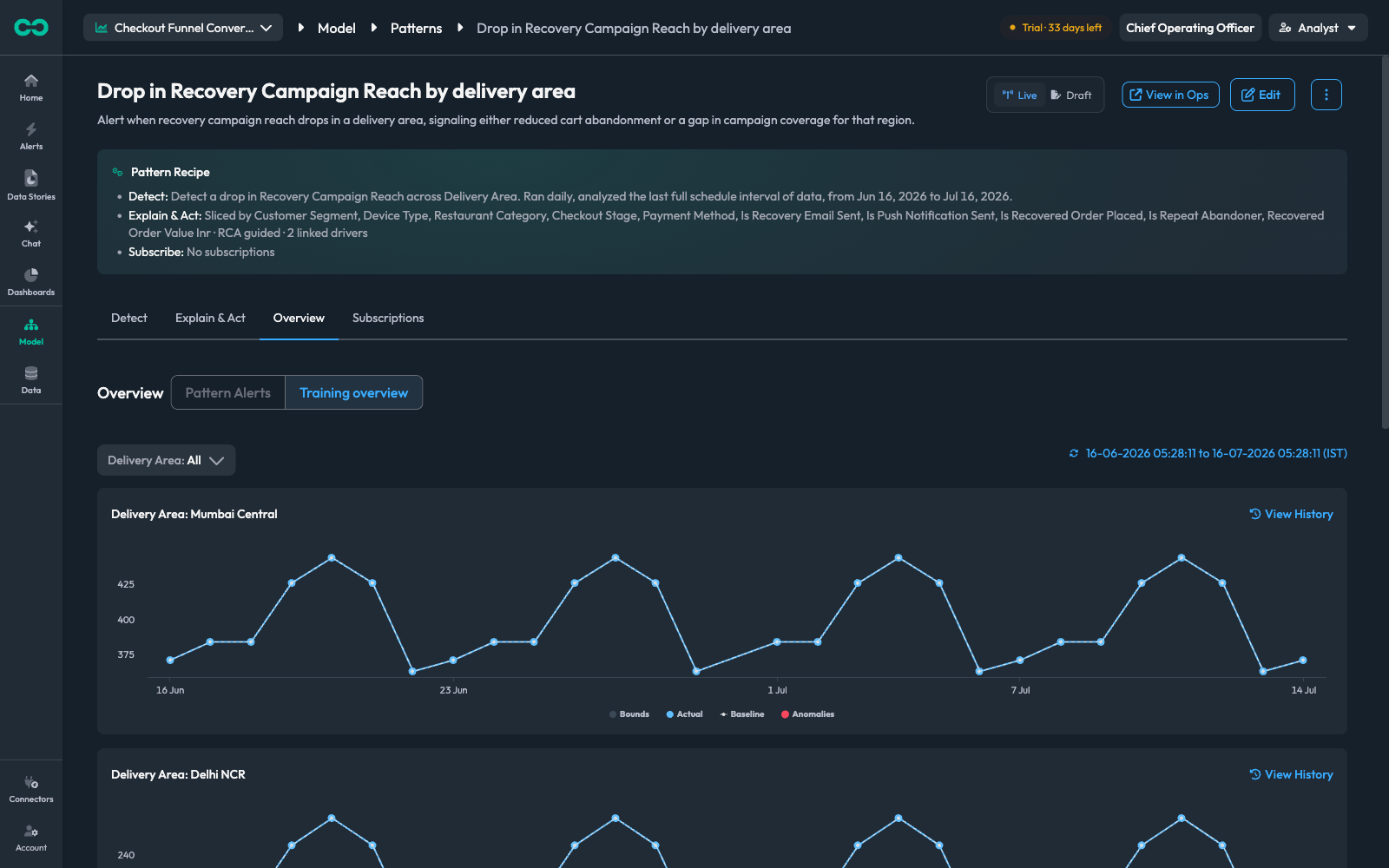
Each chart plots four series:
| Series | Meaning |
|---|---|
| Actual | The KPI's observed value |
| Baseline | The expected value from the pattern's history |
| Bounds | The band around the baseline — the tolerance before something counts as an anomaly |
| Anomalies | Points that fell outside the band in the watched direction |
Use the segment dropdown at the top left to filter to one segment, and View History on any chart to see further back.
Reading these charts is the fastest way to diagnose a misconfigured pattern:
- Anomalies everywhere — the band is too tight (raise Bound size) or the baseline has the wrong seasonality.
- No anomalies during a real incident — the band is too wide, or the Fire alert when rules are set too high.
- A regular sawtooth crossing the band — the seasonality is wrong. A KPI with a weekly rhythm needs a Weekly baseline.
Pattern alerts
The active alerts this pattern has produced, from the inbox, over a date range you pick. An empty list here on a pattern you expect to be firing usually means one of three things: the pattern is a draft (findings are withheld from the feed), the date range does not cover a run, or the Fire alert when rules are filtering everything out.
Subscriptions
A subscription routes a pattern's alerts to a destination. A pattern with no subscriptions still detects and still shows alerts in the inbox — it just does not push them anywhere.
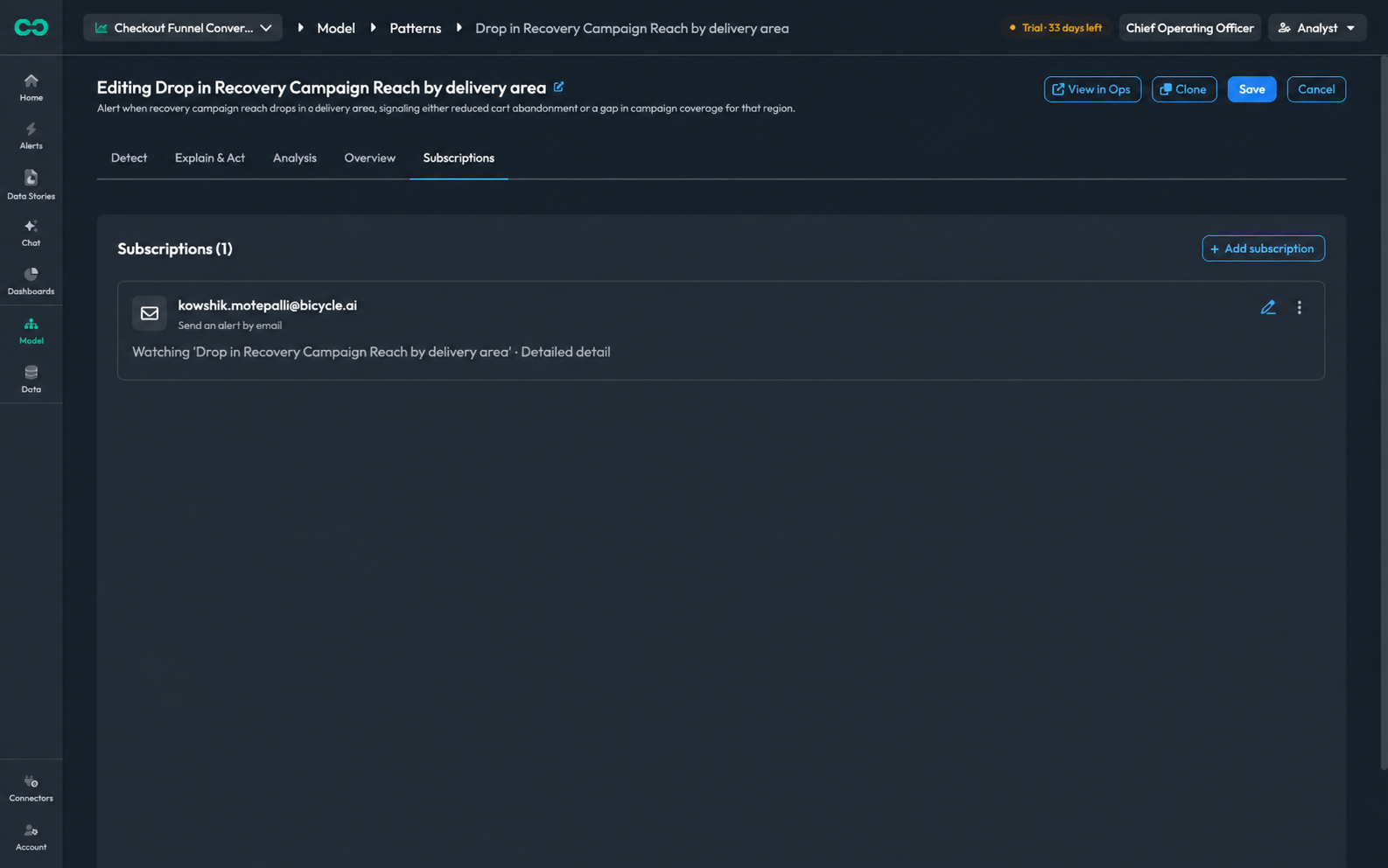
Click Add subscription to open the composer. The left side configures delivery; the right side previews the exact message that will be sent, built from this pattern's real data.
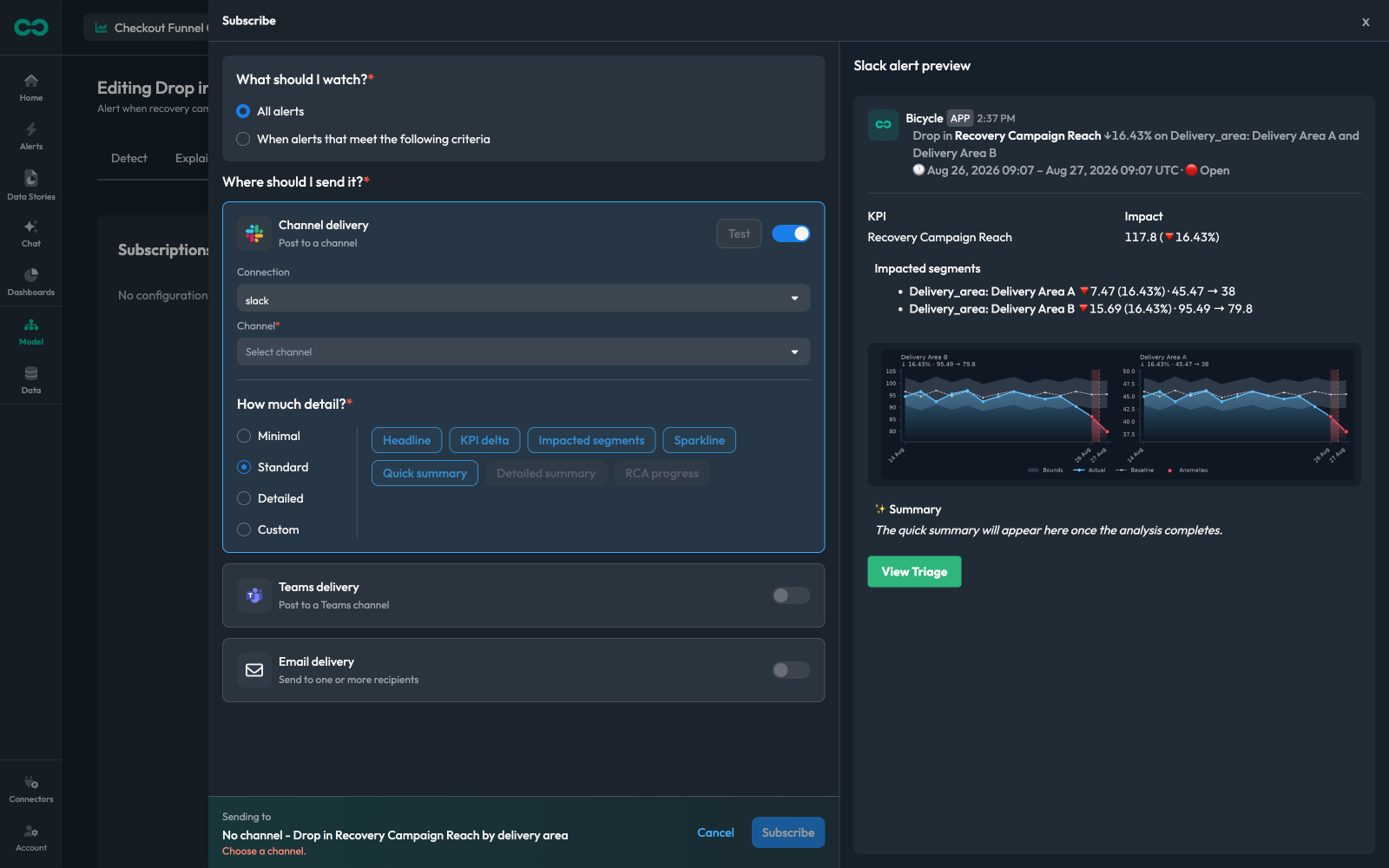
What should I watch?
All alertsDefault: selectedEvery alert this pattern produces.
When alerts meet the following criteriaOnly alerts matching conditions you specify — useful for routing severe alerts to an on-call channel while everything else goes to a team channel.
Where should I send it?
Three delivery methods, each toggled independently. One subscription can use more than one.
Channel deliveryPost to a Slack channel. Pick the Connection, then the Channel. Test sends a sample message so you can confirm the destination before saving.
Teams deliveryPost to a Microsoft Teams channel.
Email deliverySend to one or more recipients.
How much detail?
Four presets, plus per-block control:
| Preset | Best for |
|---|---|
| Minimal | High-volume patterns where the headline is enough |
| Standard | The default — headline, KPI delta, impacted segments, sparkline, and a quick summary |
| Detailed | Adds the full analysis summary and RCA progress |
| Custom | Pick the blocks yourself |
The blocks are Headline, KPI delta, Impacted segments, Sparkline, Quick summary, Detailed summary, and RCA progress. Selecting a preset highlights the blocks it includes; Custom lets you toggle them individually.
The preview on the right updates as you change these, showing the real message — the KPI and its delta, the impacted segments with their before-and-after values, sparklines with the anomaly marked, the summary block, and a View Triage button linking back into Bicycle.
Subscribe stays disabled until a destination is complete. The footer tells you what is missing — "No channel — choose a channel."
Subscriptions are saved through their own API, separately from the rest of the pattern config. Adding or removing one never creates a new pattern, and never needs a Save on the edit page.